


Geogrids Used in Road Construction
Types of Geogrids for Road Construction
·Warp-Knitted Geogrids: These geogrids are made from glass fiber or polyester yarns woven in both longitudinal and transverse directions by a warp-knitting machine. This process creates a basic mesh material that utilizes the strength of the yarns to provide tensile strength, tear resistance, and creep resistance. The geogrids are then coated with a pre-fabricated latex through a special process. Common types include fiberglass geogrids and polyester geogrids.
·Plastic Stretched Geogrids: These geogrids are made from polypropylene (PP) or polyethylene (PE) through extrusion, punching, and stretching processes.Uniaxial stretched plastic geogrids are stretched only in one direction, while biaxial stretched plastic geogrids are stretched in both longitudinal and transverse directions, providing equal strength in both directions.
·Welded Composite Geogrids: This category includes steel-plastic geogrids and plastic welded geogrids. Steel-plastic geogrids combine high-strength steel wires with polyethylene (PE) and other corrosion-resistant, aging-resistant components. These are then wrapped with plastic and bonded using a special welding technique. Plastic welded geogrids, in contrast, are made from polypropylene (PP) and are joined by welding.
Advantages of Geogrids in Road Reinforcement
Geogrids offer several advantages in subgrade and pavement reinforcement for roads. They provide reinforcement, seismic resistance, crack prevention, and mitigation of uneven settlement. Compared to concrete and other materials, geogrids not only offer superior performance and higher efficiency but also extend road lifespan and lower construction costs. Studies show that using geogrids can enhance construction efficiency by 30% to 50%. Due to these benefits, geogrids are widely used globally.
Additionally, the seismic resistance of geogrid-reinforced roads has garnered attention from governments worldwide. During major earthquakes such as the Hanshin Earthquake in Japan, the Northridge Earthquake in the USA, the El Salvador Earthquake in the Americas, and the Wenchuan Earthquake in China, roads reinforced with geogrids generally performed well and demonstrated effective seismic resistance.
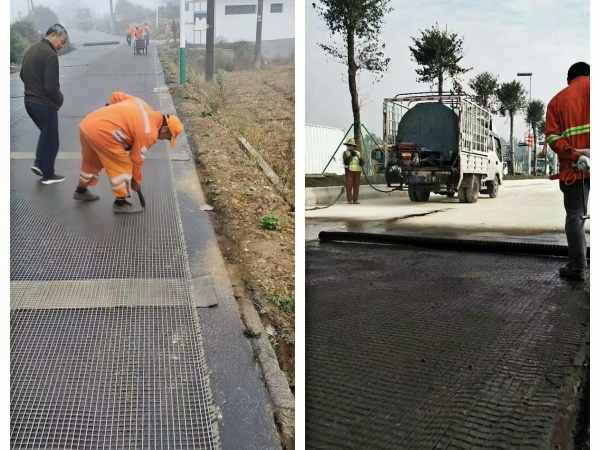
Advantages of Geogrids in Road Reinforcement
·Enhanced Load-Bearing Capacity: Geogrids improve load distribution due to their unique mesh structure, increasing the overall load-bearing capacity of soil layers. Typically installed in subgrade or base layers, geogrids combine with materials like sand, gravel, and asphalt to form a robust composite structure, which enhances road stability and reduces settlement and deformation caused by vehicle loads.
·Extended Lifespan: Geogrids resist corrosion and aging, allowing them to withstand harsh conditions over extended periods. Their use significantly prolongs road lifespan and reduces maintenance and replacement needs, lowering maintenance costs and improving safety and efficiency.
·Reduced Subgrade Settlement and Deformation:Geogrids enhance soil integrity and stability, minimizing settlement and deformation in subgrades. Their mesh structure effectively limits soil particle movement, increasing internal friction and cohesion, which improves shear strength and stability.
·Improved Pavement Performance: Fiberglass geogrids, when combined with asphalt mixtures, form a tight composite that enhances pavement load-bearing and shear resistance. They significantly reduce issues such as reflective cracking and rutting in asphalt pavements, thereby improving the road's lifespan and safety.
·Simplified Construction: Geogrid installation is relatively simple and quick, making the construction process more efficient. Their lightweight and transport-friendly nature ease the installation process, reducing construction difficulty and cost. Geogrid installation usually requires minimal specialized equipment, simplifying the process for construction personnel.
·Environmental and Energy Benefits:Geogrids are environmentally friendly and energy-efficient. Their production process is relatively simple, and the materials are recyclable, aligning with sustainable development principles. Geogrid use also reduces excavation and backfill volumes, minimizing environmental impact. By extending road lifespan and decreasing maintenance frequency, geogrids indirectly lower energy consumption and carbon emissions.
In summary, geogrids play a crucial role in driveway construction. Different types of geogrids cater to various engineering conditions and needs. They significantly enhance road load-bearing capacity and stability, extend service life, reduce settlement and deformation, improve pavement performance, and simplify construction. Additionally, their environmental benefits support sustainable development goals. Consequently, the future of geogrid application in road construction looks promising and expansive.


