

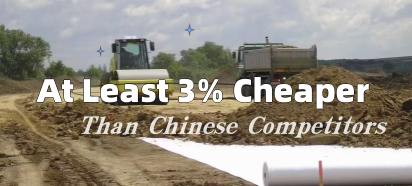
Production Process of Non woven Geotextile fabric
Nonwoven geotextile fabrics are made from short fibers or long filaments arranged randomly or orientated, and then bonded together mechanically, thermally, or chemically. Unlike traditional woven geotextile, which use weaving processes to interlace fibers, nonwoven geotextiles are directly reinforced into fabric using physical or chemical methods. Therefore, nonwoven geotextile is also referred to as non-woven geotextile.
Classification of Non woven Geotextile fabric
• By Production Process:
o Short Fiber Needle-Punched Nonwoven Geotextile
o Continuous Filament Spunbond Needle-Punched Nonwoven Geotextile
• By Raw Material:
o Polypropylene Nonwoven Geotextile(also known as Polypropylene Nonwoven Geotextile or PP Nonwoven Geotextile)
o Polyester Nonwoven Geotextile (also known as PET Nonwoven Geotextile, Polyester Geotextile)
From this, it can be seen that, staple fiber needle-punched nonwoven geotextile can be made from either polypropylene or polyester. Similarly, Filament spunbond needle-punched nonwoven geotextile is the same as well. In other words, whether it's polyester nonwoven geotextile or polypropylene nonwoven geotextile, both can be produced using staple fiber needle-punching or spunbond needle-punching processes. The same material, different processes, result in different production costs and product performance parameters.
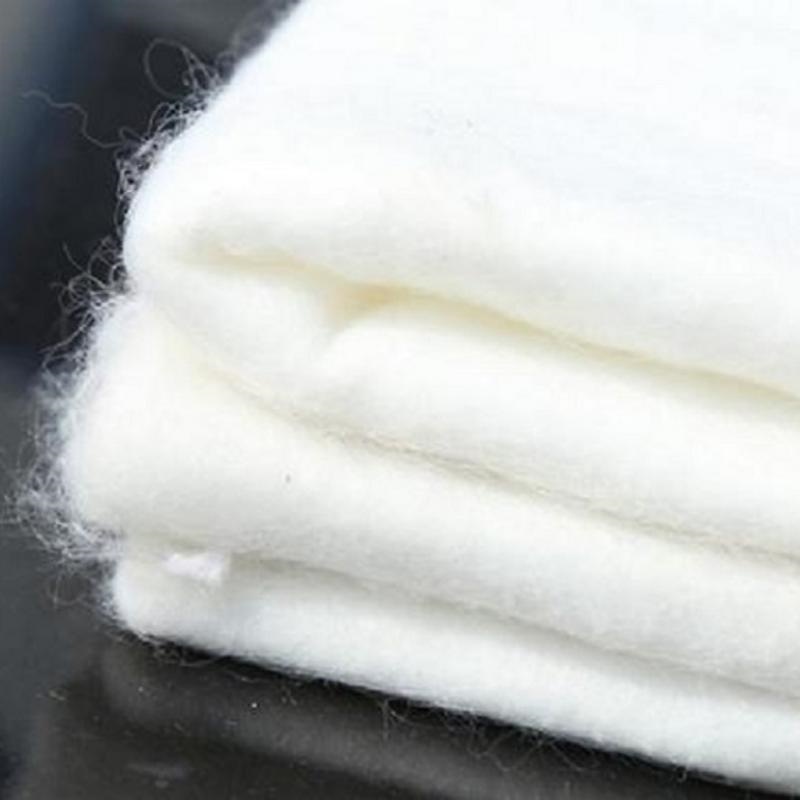

Performance Characteristics and Advantages of Non woven Geotextile(Filter and Drainage Fabric)
Due to the simpler production process of non woven geotextile, their manufacturing efficiency is higher, and production costs are lower. This makes them well-suited for large-scale construction projects and filter drainage projects. Additionally, nonwoven geotextile have larger pores compared to woven geotextile, offering better water and air permeability,this is very suitable for drainage and filter. While the mechanical properties of nonwoven geotextile may not be as stable as those of woven geotextile, they still provide sufficient tensile strength and corrosion resistance for most projects. Furthermore, nonwoven geotextile offer greater flexibility and adaptability, making them easier to handle and install. Overall, nonwoven geotextiles are more capable of meeting the needs of most construction projects.
Broad Applications of Nonwoven Geotextile
Due to their excellent performance and versatility, nonwoven geotextile fabrics are widely used in various fields, including land engineering, highway construction, and building projects. They can be utilized for soil reinforcement and stabilization, preventing soil erosion, serving as reinforcement layers, drainage and filter projects, sound insulation layers, and filtration layers, among other uses.