

Geocells for Retaining Walls
Introduction
In civil engineering, retaining walls are critical structures for maintaining soil stability, preventing landslides, and protecting surrounding buildings. The design and material selection for these walls are crucial. Recently, geocells, an innovative geosynthetic material, have become increasingly popular in retaining wall construction due to their unique structure and excellent performance. This article explores the specifications, applicability, advantages, and comparisons of geocells used in retaining walls.
Specifications for Geocells in Retaining Walls
Size and Shape
Geocells are typically made from high-strength, corrosion-resistant polymer materials and are formed into interconnected cells through heat welding or mechanical connections. These cells come in various sizes and shapes to meet different engineering needs. In retaining wall construction, the size of the geocells is usually determined by factors such as wall height, soil conditions, design loads, and drainage requirements. Larger cell sizes are suited for better soil conditions and lower loads, while smaller cell sizes are appropriate for poorer soil conditions and higher loads.
Strength and Stiffness
The strength and stiffness of geocells are crucial for their effectiveness as reinforcement materials in retaining walls. These performance parameters are influenced by the material type, thickness, production process, and cell size. For retaining walls, geocells must have sufficient tensile strength, shear strength, and deformation resistance to withstand soil pressure and lateral forces, ensuring the stability of the wall.
Permeability
Good permeability is a key advantage of geocells in retaining wall construction. The grid structure of geocells allows moisture to flow freely through the soil, helping to reduce water pressure behind the wall and decrease the soil's pushing force on the retaining wall. Therefore, it is important to consider whether the permeability of the geocells meets the engineering requirements.
Why Geocells are Suitable for Retaining Walls
Increased Stability
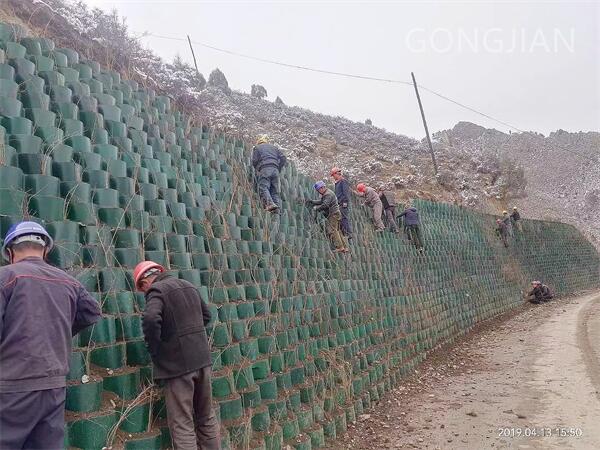
Geocells, with their unique grid structure, can effectively lock soil particles within the cells, forming a stable soil structure. This structure significantly improves the retaining wall's resistance to sliding, overturning, and deformation, ensuring stability in complex geological conditions and harsh environments.
Enhanced Soil Bearing Capacity
The interaction between geocells and soil enhances the soil's bearing capacity. When soil fills the geocell cells, friction between the soil particles and the geocell walls increases, thereby improving the soil's shear strength. This enhanced bearing capacity helps distribute soil pressure, reduce the load on the retaining wall, and extend its lifespan.
Improved Drainage and Pressure Relief
As mentioned, geocells have good permeability, which helps reduce water pressure behind the wall and minimizes the soil's pushing force on the retaining wall. Improved drainage also helps prevent soil saturation and softening, further enhancing the stability of the retaining wall.
Strong Adaptability and Flexibility in Construction
Geocells can be customized to meet specific engineering needs, adapting to different terrains, soil conditions, and design requirements. Additionally, geocells are relatively easy to install and can be used with various materials such as soil, gravel, and concrete, offering more options for retaining wall construction.
Advantages of Retaining Walls Made with Geocells
Longevity
Geocells are made from high-strength, corrosion-resistant polymers, providing excellent durability and long-term stability. Under normal conditions, geocells can last for several decades or more, making retaining walls constructed with geocells more economical and sustainable.
Cost Efficiency
Although the initial investment in geocells may be slightly higher than some traditional materials, their long-term stability and low maintenance costs make them more cost-effective overall. Moreover, the ease and speed of geocell installation can shorten construction time and further reduce project costs.
Strength and Stability
As previously mentioned, geocells enhance the strength and stability of retaining walls through their unique grid structure and interaction with soil. This improved performance allows retaining walls made with geocells to better withstand soil pressure, water pressure, and natural disasters such as earthquakes.
Reliability
Geocells undergo strict quality control and performance testing during design and construction to ensure they meet engineering requirements. The tight integration between geocells and soil also increases the overall reliability of the retaining wall. Geocells maintain stable performance over time, providing reliable support and containment.
Comparison withGeogrid Retaining Walls
Similarities
Enhanced Stability: Both geocells and geogrids enhance the stability of retaining walls through their unique structures, improving resistance to sliding, overturning, and deformation.
Improved Drainage: Both materials have good permeability, helping to reduce water pressure behind the wall and decrease the soil's pushing force on the retaining wall.
Flexible Construction: Both can be customized and used with various materials, offering flexible solutions for retaining wall construction.
Differences
*Structural Form:
Geocells: Feature a three-dimensional grid structure with interconnected cells that create a compact and stable soil structure. This three-dimensional structure effectively restricts soil particle movement.
Geogrids: Have a two-dimensional planar mesh structure made up of horizontal and vertical reinforcement ribs. Although they also constrain soil particles, their planar structure offers less spatial confinement compared to geocells.
Geocells: Particularly suitable for retaining walls requiring high stability and drainage performance, such as high embankments, riverbanks, and slope reinforcement.
Geogrids: More widely used in foundation reinforcement, pavement construction, and soft soil treatment. Their planar structure is effective for increasing foundation bearing capacity and reducing settlement.
Geocells: The three-dimensional structure requires more precise installation to ensure correct cell filling and connection. However, advancements in construction techniques have simplified this process.
Geogrids: Their simpler two-dimensional structure makes installation easier and quicker, providing advantages in construction speed and efficiency.
Geocells: Although initial costs may be higher, their long-term stability and low maintenance costs provide significant overall cost benefits, especially in high-stability applications.
Geogrids: Offer good cost efficiency due to lower initial costs and broad applicability. They are a more economical choice for projects with less stringent stability and durability requirements.
Both geocells and geogrids are made from polymer materials that are corrosion-resistant and recyclable. They do not pollute the environment during use. However, geocells may offer better performance in reducing soil erosion and protecting ecological environments.
*Applicability:
*Construction Difficulty:
*Cost Efficiency:
*Environmental Performance:
In conclusion, geocells, as a high-performance geosynthetic material, offer significant advantages for retaining wall construction. Their unique three-dimensional structure, strong spatial confinement, good drainage performance, and construction flexibility make them excellent in terms of longevity, cost, strength, and reliability. Compared to geogrids, geocells are more suitable for specific projects requiring high stability and durability. Thus, for retaining wall construction, careful consideration of project requirements and conditions is essential to ensure the safety, economy, and sustainability of the construction.

