

Geocells for Slope Reinforcement, Protection, and Erosion Control
Geocells are used for slope protection, proving highly effective for slope reinforcement and erosion control. They offer high construction efficiency, low costs, excellent performance, and long durability, making them an outstanding material for controlling slope erosion. This article provides a comprehensive overview of geocells from the perspectives of material principles, application advantages, construction overview, and considerations.
Introduction to Geocells
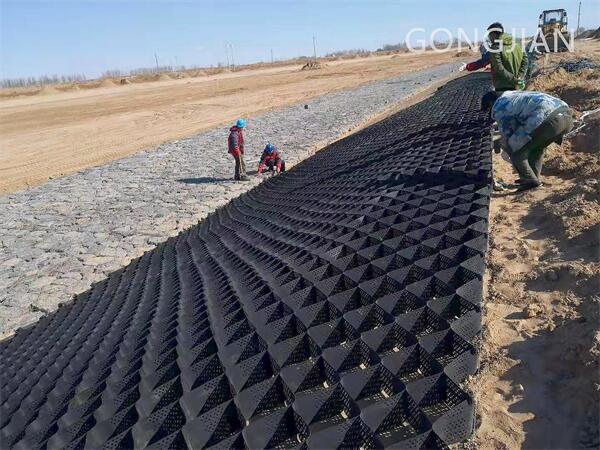
Geocells are three-dimensional cellular plastic products made from high-strength synthetic materials (such as polymer materials) through a special welding process. This structure has excellent strength, rigidity, flexibility, and impact resistance. Geocells can expand and fill with soil or gravel, creating a unified flexible structure that significantly enhances the load-bearing capacity and stability of the soil. They have become essential materials for various engineering slope reinforcement and protection projects.
Principle of Geocell Reinforcement for Slopes
1. Increasing Soil Shear and Friction Strength
After filling geocells with soil, they form a stable overall structure that effectively increases the soils shear and friction strength. This enhancement significantly improves the soils resistance to sliding and instability, preventing slope failures and erosion.
2. Enhancing Soil Erosion Resistance
During rainfall or water flow, geocells can block direct water erosion on the soil because the soil is contained within the cells and is less likely to be washed away. This characteristic of enhancing soil erosion resistance is a crucial technology for preventing slope erosion.
3. Improving Drainage Performance
Geocells have good drainage capabilities, allowing for the rapid removal of accumulated water from slopes, reducing soil moisture content, and increasing slope stability. Proper drainage design further reduces the risk of landslides due to excess water.
4. Promoting Vegetation Growth and Slope Stability
The three-dimensional structure of geocells not only provides stable support for the soil but also creates favorable conditions for vegetation growth. The gaps in the geocells allow plant roots to penetrate and deepen into the soil. As vegetation grows, the roots expand and integrate closely with the soil, forming a stable system where biological and soil interactions enhance slope stability and control erosion more effectively.
Advantages of Geocell Reinforcement for Slopes
1. Good Stability
As mentioned, geocells significantly enhance slope stability by improving soil shear strength, friction, and erosion resistance, effectively preventing landslides and erosion.
2. Simple Construction and Low Cost
The construction process for geocells is relatively straightforward, requiring minimal specialized equipment and skills. The lower material costs reduce the overall construction expenses. Additionally, the short construction period and minimal environmental impact enhance the projects economic feasibility.
3. Strong Environmental Benefits
As a geosynthetic material, geocells offer excellent environmental performance. The construction process generates minimal waste and pollutants and integrates with vegetation to form an eco-friendly slope protection system, contributing to environmental restoration and protection.
4. Promotion of Vegetation Growth and Long-Term Benefits
Geocells design supports plant growth and development. As vegetation flourishes, its roots tightly bond with the soil, creating a natural protective layer. This combination of biological and engineering aspects not only enhances slope stability but also improves ecological function and landscape value. Over time, the vegetation cover continues to provide protection, preventing erosion and ensuring sustainable slope protection.
Construction Overview for Using Geocells in Slope Protection
1. Pre-Construction Preparation
Before construction, the slope should be leveled to meet design requirements. Remove loose stones and hazardous debris from the slope to prevent damage to the geocells during installation. Determine the geocell placement direction and spacing based on project needs.
2. Geocell Installation
Geocells should be laid according to the planned direction and spacing. The cells should be installed with the primary load direction in mind, from top to bottom, ensuring the geocell panels are perpendicular to the roadbed or slope direction.
3. Filling with Soil or Gravel
After the geocells are stretched and secured, fill them with soil or gravel as needed. This should be done from top to bottom, ensuring the compaction and uniformity of the fill material.
4. Vegetation Coverage
Once the slope reinforcement is complete, cover the geocell surface with vegetation to enhance aesthetics and ecological benefits. Vegetation not only improves slope protection but also enhances the ecological environment and microclimate. When selecting plant species, consider growth habits, resistance to adverse conditions, and aesthetic effects to ensure successful vegetation coverage.
Geocells, as a new and efficient material for slope reinforcement and protection, offer significant advantages in preventing slope erosion and increasing stability. With proper construction design and process control, geocells can fully realize their reinforcement and protection effects, ensuring the safety and stability of engineering structures. As technology advances and application fields expand, geocells will play a crucial role in civil engineering development.


