

Introduction to Polypropylene Non woven Geotextiles
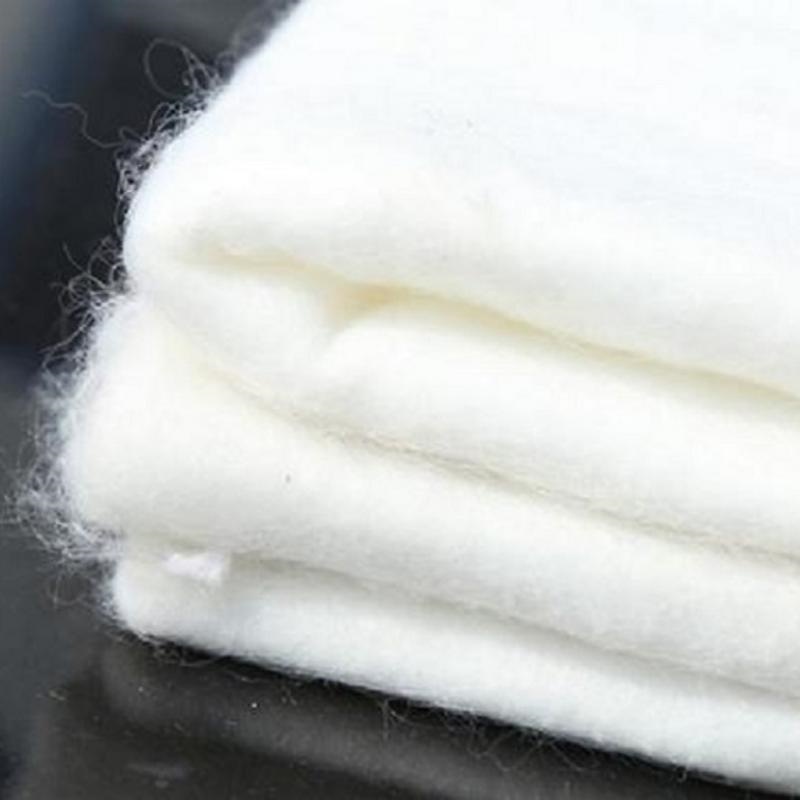
Polypropylene nonwoven geotextile, also known as polypropylene geotextile, is a type of non woven fabric made primarily from polypropylene (PP) through specific processing techniques. Polypropylene, as a high polymer compound, boasts excellent chemical resistance, abrasion resistance, aging resistance, and high tensile strength. Consequently, polypropylene nonwoven geotextiles are widely used in civil engineering. The production processes mainly include staple fiber needle-punching and filament spunbond needle-punching, each with its own characteristics to meet different engineering needs.At the end of the article, a table of product specifications and performance parameters is attached.
Production Processes for Polypropylene Nonwoven Geotextiles
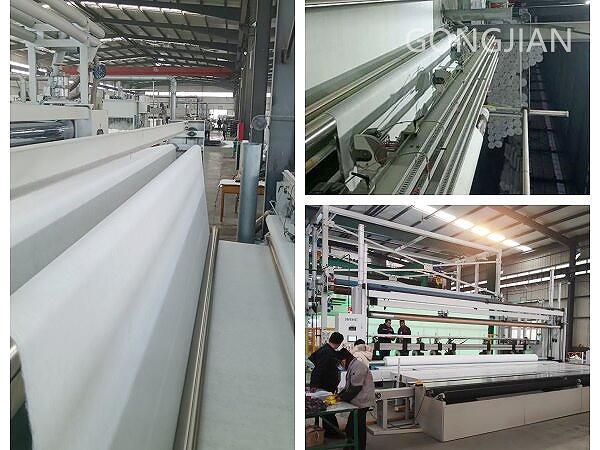
Polypropylene non woven geotextiles are mainly produced using two methods: staple fiber needle-punching and continuous filament spunbond needle-punching:
• Staple Fiber Needle-Punching
This process involves dense needle punching to create strong mechanical entanglement between fibers. The needle board on the needle-punching machine repeatedly pierces the fiber web, causing the fibers to interlock and adhere, thereby forming a nonwoven geotextile with a certain level of strength and stability. Factors such as the choice of raw materials, fiber web arrangement, and reinforcement methods significantly impact the product's performance.
• Continuous Filament Spunbond Needle-Punching
The production process of continuous filament spunbond needle-punched non woven geotextile involves two main steps:
Spunbonding: Continuous filaments of polymer (such as polypropylene) is extruded and laid down in a web-like structure.
Needle-punching: The web is then passed through a needle-punching machine, where barbed needles entangle the fibers to enhance the fabric's strength and structure.
This combination results in a non woven geotextile with high tensile strength, durability, and permeability, ideal for use in geotechnical applications.
Classification and Characteristics of Polypropylene Nonwoven Geotextiles
• Staple Fiber Needle-Punched Polypropylene Non woven Geotextile
This type of geotextile has evenly distributed fibers, a fluffy structure, good air and water permeability, easy construction, and relatively low cost. It is suitable for applications requiring good drainage performance, such as embankments and slope protection.
• Continuous Filament Spunbond Needle-Punched Polypropylene Nonwoven Geotextile
Compared to staple fiber needle-punched geotextiles, filament spunbond needle-punched nonwoven geotextiles have higher tensile strength and puncture resistance. They have a smooth, even surface and good durability, making them more suitable for projects requiring higher strength, such as large-scale water conservancy projects and transportation engineering.
Comparison of Polypropylene Non woven Geotextiles (PP) and Polyester Geotextiles
Although polypropylene geotextiles and polyester (PET) geotextiles are both types of nonwoven geotextiles, their raw materials differ, resulting in performance variations:
Polypropylene Nonwoven Geotextile (PP)
Advantages: Strong acid and alkali resistance, high corrosion resistance, good aging performance, and relatively economical price.
Disadvantages: Performance may slightly decrease under extreme conditions such as high temperatures or strong UV radiation.
Polyester Nonwoven Geotextile (PET)
Advantages: Higher UV resistance and thermal stability, suitable for use in more complex environments.
Disadvantages: Higher price compared to polypropylene.
Selection Recommendations:
If your project has budget constraints and operates in relatively mild environmental conditions, polypropylene geotextile is a cost-effective choice.
For projects in harsher environments, such as high temperatures or strong UV exposure, polyester geotextile may be more appropriate.
Why Polypropylene Nonwoven Geotextiles Are Less Expensive
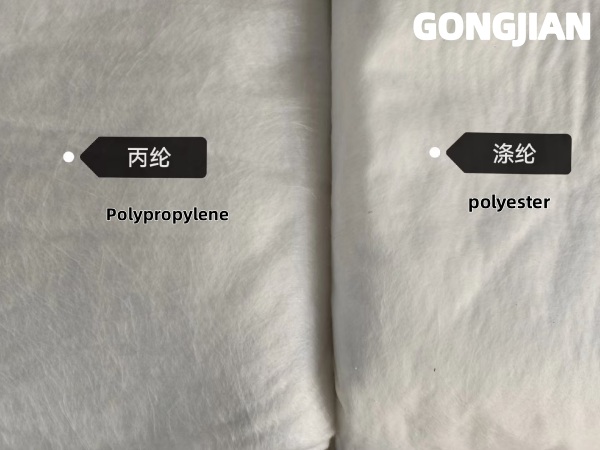
Polypropylene fibers are the lightest among all chemical fibers, being 34% lighter than polyester fibers of the same volume. For geotextiles with the same unit area weight, polypropylene geotextiles contain more fiber material per unit area than polyester geotextiles, resulting in better mechanical performance and enhanced reinforcement and protection functions. International standards and engineering designs use nominal tensile strength specifications, such as: commonly used 20kN/m geotextiles in water conservancy projects, which can be available in two options: PET20—4—400 and PP20—4—300. Here, 20 represents the nominal tensile strength, 4 represents the width, and 400 and 300 represent the unit area weight. Thus, one ton of polyester geotextile covers 2500 m², whereas one ton of polypropylene geotextile covers 3333 m², providing 833 m² more coverage.
Applications of Polypropylene Nonwoven Geotextiles (Polypropylene Geotextiles)
Due to its excellent performance characteristics, polypropylene geotextile is widely used in various fields:
• Water Conservancy Engineering
Used for seepage prevention, filtration, reinforcement, and drainage in embankments, reservoirs, river channels, etc., enhancing the stability and durability of the projects.
• Transportation Engineering
Applied in roadbeds, slopes, and retaining walls for highways and railways to improve soil stability and load-bearing capacity.
• Environmental Engineering
Used as lining material in landfills and sewage treatment plants to prevent the leakage and spread of pollutants.
• Construction Engineering
Applied in walls and floors of basements and underground garages in humid environments to provide moisture protection and separation.
Product Specifications and Performance
PP Needle Punched Non-woven Geotextile:
| Index Properties | Test Method | Unit | |||||||
| Weight | ASTM D5261 | g/m2 | 100 | 150 | 200 | 300 | 400 | 500 | 600 |
| Ultimate Tensile Strength | ASTM D4595 | ≥kN/m | 3.5 | 6 | 8.5 | 13 | 18.5 | 23 | 28 |
| Grab Tensile Strength | ASTM D4632 | ≥N | 270 | 460 | 550 | 930 | 1180 | 1400 | 1720 |
| Trapezoid Tear Strength | ASTM D4533 | ≥N | 110 | 165 | 220 | 330 | 445 | 560 | 640 |
| CBR Puncture Strength | ASTM D6241 | ≥N | 500 | 1120 | 1600 | 2430 | 3390 | 4110 | 5500 |
| Puncture Resistance | ASTM D4833 | ≥N | 141 | 261 | 382 | 565 | 817 | 970 | 1130 |
| Drop Cone Resistance(hole-φ) | BS EN 918 | mm | 39 | 33 | 30 | 24 | 16 | 15 | 13 |
| Hydraulic Properties | |||||||||
| Apparent Opening Size O90 | ASTM D4751 | ≤mm | 0.13 | 0.12 | 0.12 | 0.11 | 0.09 | 0.08 | 0.08 |
| Permeability | ASTM D4491 | cm/s | 0.41 | 0.41 | 0.41 | 0.4 | 0.39 | 0.39 | 0.39 |
| Physical Identification Properties | |||||||||
| Thickness | ASTM D5199 | mm | 1 | 1.7 | 2.1 | 2.5 | 3 | 3.5 | 3.8 |
| Approx Load Qty per 40HQ | M2 | 72000 | 48000 | 36000 | 24000 | 18000 | 14000 | 12000 | |
In summary, polypropylene nonwoven geotextiles (polypropylene geotextiles) are indispensable in the field of civil engineering due to their unique performance characteristics and wide range of applications. As a supplier, manufacturer, and exporter of polypropylene non-woven geotextile ,this introduction aims to help you better understand polypropylene geotextiles and provide strong support for your engineering decisions.
